Factors responsible for the Gold price increase

Gold prices have reached a record level. The factors responsible for increase in gold price are

  • Purchase of Gold by Central banks: The Reserve bank of India recently purchased 200 tonnes of Gold, which led to the price increase in the international and indian gold markets. Other central banks of Asia and Latin America are also buying gold.
  • Demand for Gold in developing countries like China and India: The rapid GDP growth rate, emergence of middle class in the rapidly developing countries is leading to the demand for Gold in international market. The cultural affinity towards gold also plays a major role in demand from India.
  • Slowdown in World Economy: As most western economies including USA, UK and EU are facing economic slowdown, more number of investors are looking for safer alternatives like gold.
  • Gold is inflation proof, which makes it as a prime investment option.
References:


What is a hawala transaction ?

Hawala means transfer in arabic language. Hawala is an informal alternative foreign remittances transfer system based on the trust of a huge network of money brokers.

It is not a legal method of money transfer, because it evades foreign exchange rate regulations, tax, currency control, immigration, and other concerns. The hawala brokers charge less commission than the banks, which makes it attractive to the common people.

Hawala is also used to circulate black money and to terrorism funds, drug trafficking and other illegal activities. The Governmentt of India made, FEMA (Foreign Exchange Management Act) 2000 and PMLA ( Prevention of Money Laundering) Act 2002 to curb these activities.

Hawala brokers transfer money without moving it physically.

Steps involved in Money Transfer in a Hawala Transaction:
  1. A customer approaches a hawala broker in one city and gives a sum of money that is to be transferred to a recipient in a foreign country.
  2. The hawala broker calls another hawala broker in the recipient's city, and gives instructions about the funds.
  3. The recipient collects the money from the hawala broker in his city. 
  4. Settlements of debts between hawala brokers can take a variety of forms, such as goods, services, properties, transfers of employees, etc. and need not take the form of direct cash transactions.

Index of Eight Core Industries - India

Index of Eight Core Industries (Base: 2004-05=100). 

The Eight core industries have a combined weight of 37.90 per cent in the Index of Industrial Production (IIP) in may 2012.

During April-May 2012-13, the cumulative growth rate of the Core industries was 3.4 % as against their growth at 5.0% during the corresponding period in 2011-12.

The eight core industries are
  1. Coal
  2. Crude Oil
  3. Natural Gas
  4. Refinery products
  5. Fertilisers
  6. Steel
  7. Cement
  8. Electricity

Electricity has a maximum weight of 10.32%.

Fiscal Responsibility and Budget Management FRBM Act 2003

The Fiscal Responsibility and Budget Management FRBM Act 2003 aims to achieve financial discipline, reduce fiscal deficit, improve macro economic management.

The main purpose of FRBM Act 2003 was to eliminate revenue deficit(RD) and bring down the fiscal deficit (FD) to a manageable 3% of GDP by march 2008.

The FRBM Act 2003 provides for making rules to specify the annual targets for reduction of fiscal deficit and revenue deficit, contingent liabilities and total liabilities.

The main objectives of the act were
  1. to introduce transparent fiscal management system
  2. to introduce a more equitable and manageable distribution of the country's debts over the years
  3. to aim for fiscal stability for India in the long run
Along with the budget and demands for grants, the government of India should submit the following documents to the parliament.
  1. Medium-term Fiscal Policy Statement – It should present a three-year rolling target for the fiscal indicators.
  2. Fiscal Policy Strategy Statement – This should enumerate strategies and policies for the upcoming Financial Year including strategic fiscal priorities, taxation policies, key fiscal measures
  3. Macro-economic Framework Statement – This report should contain forecasts enumerating the growth prospects of the country - GDP growth etc.
The Act provided that the Central Government shall not borrow from the Reserve Bank of India(RBI) except under exceptional circumstances where there is temporary shortage of cash in particular financial year.

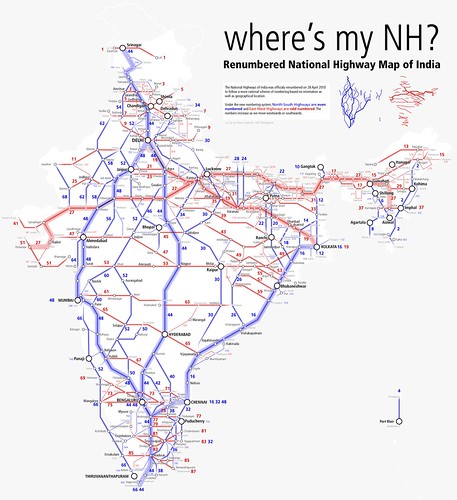
Rationalisation of Numbering system of national highways

All national highways in India are rationalised based on the US Highway numbering system. All highways are numbered based on their orientation from North to South and from East to West directions. Highways which are running from north to south are given even numbers and those running in the east-west direction are given odd numbers.

The Primary National Highways which are in N-S and E-W directions are given double digits for better identification by commuters (from 1 to 99). The numbers of the Primary National Highways increase from N-S and E-W. The Secondary National Highways are given three digit numbers.

As per the new scheme, multiple highways are merged into one new Highway. After the renumbering single longest national highway is NH 44 which will run from Srinagar to Kaniyakumari. The shortest Highway is NH-36. The distance is 3.0 km only. Some popular highways are truncated into multiple segments like the Chennai-Bangalore Old Madras Road via Chitoor (NH4) becoming N48-N40-N73-N75.

Renumbered National Highways map of India (Schematic)
Rationalisation of Numbering system of national highways
References : 
http://dorth.gov.in/writereaddata/sublinkimages/finaldoc6143316640.pdf
http://www.flickr.com/photos/arunganesh/4996257774/
http://en.wikipedia.org/wiki/List_of_National_Highways_in_India#Rationalization_of_Highway_numbers